Roads Built for Big Rigs: Understanding Commercial Vehicle Infrastructure
5 min read
When we share the road with semi-trucks, we are seeing only one half of a complex logistical equation. The vehicles themselves are subject to rigorous inspections and weight limits, but the environment they inhabit—the highways, rest areas, and mountain passes—is equally engineered. This is the world of commercial vehicle infrastructure.
Unlike the trucks that move through it, which are governed by thousands of specific operational rules, the infrastructure itself represents a different side of the regulatory coin. In our current assessment of active permits and specific administrative regulations for this category, the count stands at zero. This might seem surprising given the complexity of the highway system, but it reveals a fundamental truth about how these assets are managed: they are treated as public safety utilities rather than activities that require individual driver permits.
To understand why this infrastructure exists and how it is shaped, we must look at the factors that dictate its design—ranging from the physics of a descending mountain pass to the logistical reality of a driver’s required rest period.
The Role of Dedicated Infrastructure
Commercial vehicle infrastructure consists of three primary assets: dedicated truck parking, runaway truck ramps, and identified steep grades. These are not merely suggestions for road use; they are critical safety valves designed to accommodate the unique physical properties of heavy-duty vehicles.
A typical passenger car weighs about 4,000 pounds. A fully loaded commercial vehicle can reach a gross vehicle weight of 80,000 pounds or more. This massive difference in mass means that trucks interact with the road differently. They take longer to stop, they generate immense heat in their braking systems on descents, and they require significantly more space to maneuver and park.
The reason we see zero permits required to use a runaway truck ramp or a specific climbing lane is that these are safety-critical assets. In an emergency or a high-stress driving situation, the priority is immediate access. Regulating access through permits would be counterproductive to the goal of preventing accidents.
The Science of Steep Grades and Runaway Ramps
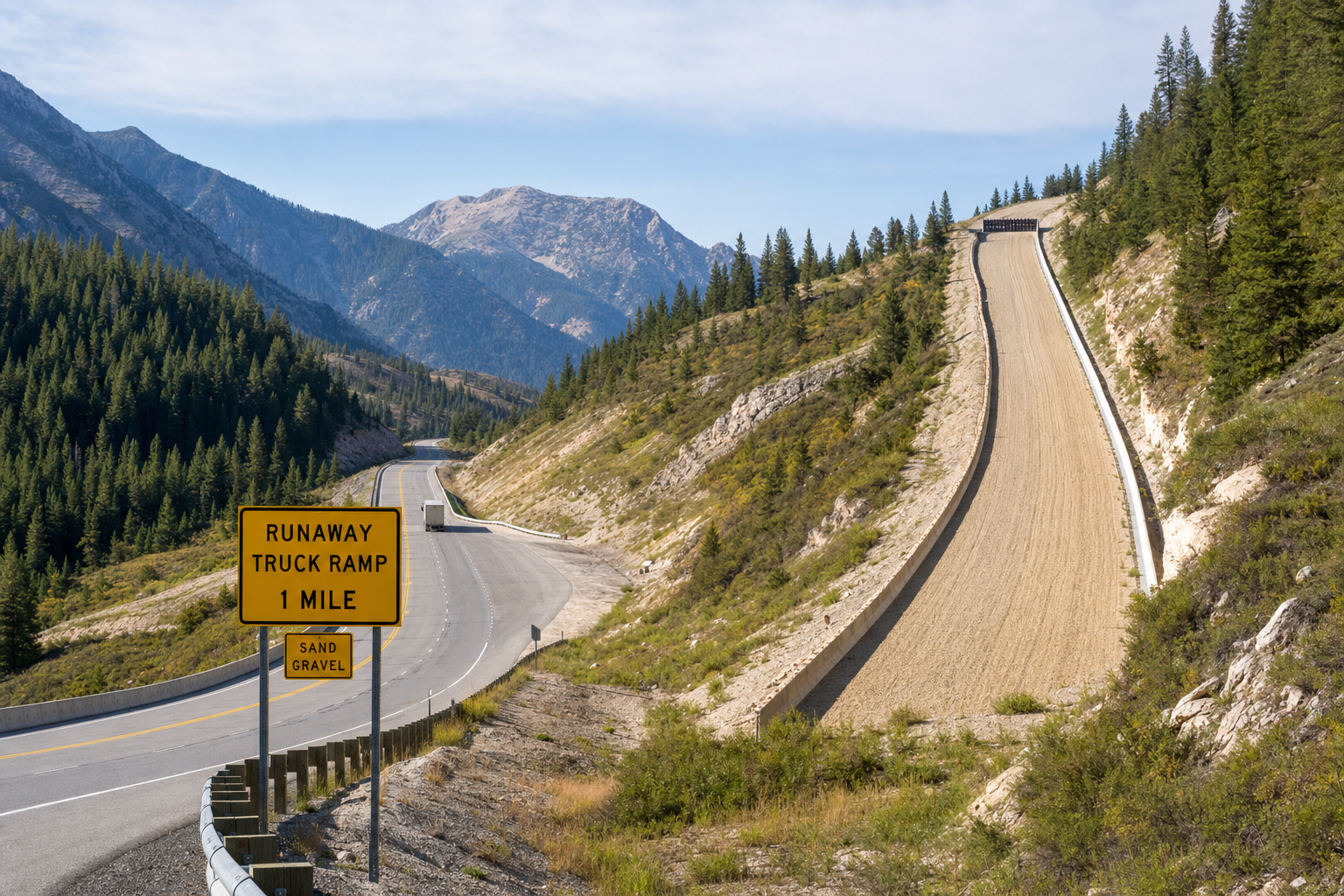
One of the most visible forms of commercial infrastructure is the runaway truck ramp, often found at the end of long, steep descents. These are not "regulated" in the sense that a driver needs a license to use them, but they are strictly governed by engineering standards.
The primary factors that determine where these ramps are placed include:
- Gross vehicle weight: Engineers calculate the maximum energy a truck at full capacity would possess if its brakes failed.
- The length and percentage of the grade: A five-mile descent at a 6% grade is fundamentally different from a two-mile descent at a 10% grade.
- Thermal limits: Constant braking on a steep hill converts motion into heat. If the brakes get too hot, they "fade" and lose their stopping power.
Infrastructure design accounts for these factors by identifying "steep grades" with specific signage and often providing "brake check" areas at the summit. These areas allow drivers to pull over and verify their mechanical systems are intact before beginning a descent. While there is no "permit" to use these areas, the rules of the road often mandate their use for vehicles over a certain weight.
The Truck Parking Crisis: A Different Kind of Infrastructure
Perhaps the most discussed aspect of commercial infrastructure today is truck parking. This is where the intersection of labor regulations and physical infrastructure becomes most apparent.
Federal hours-of-service regulations mandate that drivers take specific breaks to prevent fatigue. However, if a driver reaches their maximum driving time and there is nowhere to park, they are forced into a difficult choice: violate federal safety rules or park on the shoulder of a highway ramp, which creates a significant safety hazard for other motorists.
The "rules" surrounding truck parking are often a patchwork of local zoning and state-level management. While our data shows zero specific federal permits required to park in designated areas, the availability of these spots is shaped by:
- Freight volume: High-traffic corridors between major shipping ports and distribution centers require a higher density of parking.
- Regional land use: In densely populated areas, finding the acreage required for 50-foot or 75-foot parking stalls is difficult and expensive.
- Proximity to facilities: Infrastructure is most effective when it includes access to light, security, and basic amenities, which helps ensure drivers actually use the designated spots rather than improvising.
Why the Data Shows "Zero" Regulations and Permits
In the context of commercial carrier compliance, a "regulation" usually refers to a rule the driver or company must follow (like maintaining a logbook), and a "permit" is a specific authorization (like a permit to carry an oversized load).
The reason this category currently reflects zero regulations and zero permits is that infrastructure is a passive safety system.
- It is an engineering standard, not a behavioral mandate: The "rules" for a runaway ramp are for the civil engineers who build them, not the drivers who use them in an emergency.
- Public Access: To maximize safety, the government generally wants to remove any barriers to using this infrastructure. If a driver had to check a permit before using a climbing lane or a rest area, the efficiency and safety of the highway system would collapse.
- State vs. Federal Control: Much of this infrastructure is managed at the state level through Department of Transportation (DOT) design manuals rather than through the federal registry of motor carrier regulations.
Factors that Shape Regional Infrastructure
Geography is the ultimate regulator of commercial vehicle infrastructure. In the Great Plains, runaway truck ramps are non-existent because the terrain doesn't demand them. In the Rocky Mountains or the Appalachians, they are essential.
Regional differences are determined by:
- Terrain and Elevation: Steepness of the road is the primary driver for signage and emergency ramps.
- Climate: Areas prone to snow and ice require infrastructure like chain-up stations, which are dedicated pull-outs where drivers can safely install tire chains.
- Traffic Density: In the "megaregions" of the Northeast or Southern California, the infrastructure focuses more on managing the flow of traffic through interchanges and providing enough parking to keep trucks off narrow local streets.
Conclusion
Commercial vehicle infrastructure is the "silent partner" of the trucking industry. While it may not be defined by a long list of permits or driver-facing regulations in the traditional sense, it is one of the most highly calculated segments of our transportation network.
By understanding that these assets—the ramps, the parking lots, and the warning signs—are shaped by the physical realities of gross vehicle weight and the mechanical limits of braking systems, we can appreciate why they are maintained as open, accessible safety features. They exist to ensure that when the physics of heavy hauling meets the challenges of the natural landscape, there is a designed solution waiting to keep everyone on the road safe.