Heavy Lifting: Understanding the Regulations and Permits for Moving Specialized Equipment
5 min read
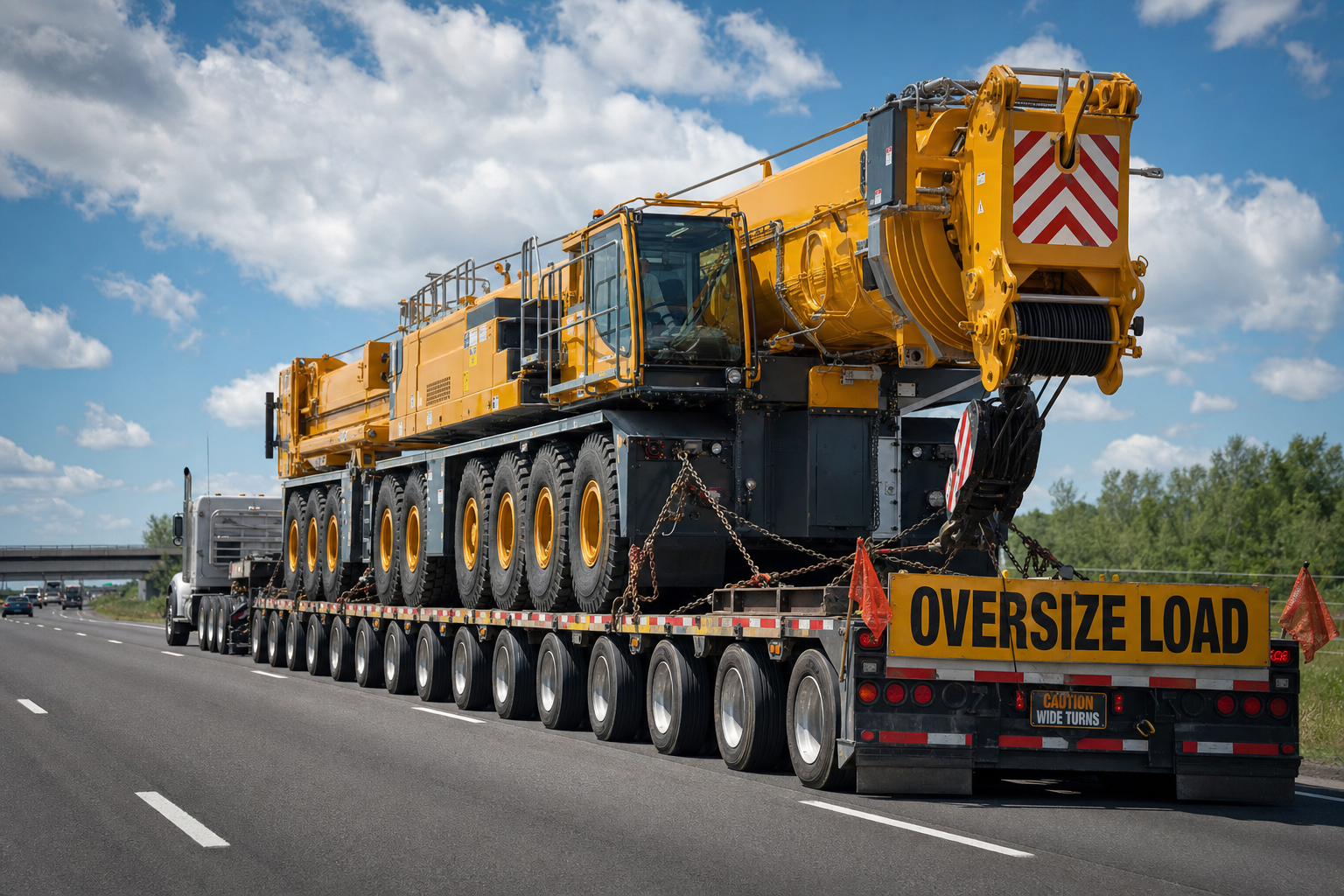
When you see a massive mobile crane, a high-reach concrete pump, or a heavy-duty drill rig moving down the highway, you are looking at a masterclass in engineering—and a significant challenge for public infrastructure. These are not standard freight trucks; they are "self-propelled equipment," designed primarily for work on a job site rather than for transporting goods. Because of their immense weight and unique dimensions, their movement is governed by a complex web of rules designed to protect roads, bridges, and public safety.
In this guide, we will explore the 22 different rules—comprised of three broad regulations and 19 specific permits—that shape how this equipment moves. Drawn from five authoritative sources, these rules ensure that our infrastructure can handle the pressure of heavy industry without crumbling under the weight.
Why the Rules Exist: A Balancing Act
The primary reason for these regulations is the protection of "the commons." Modern roads and bridges are built to withstand significant stress, but they have physical limits. A self-propelled crane might weigh three or four times more than a fully loaded semi-truck. If that weight isn't distributed correctly, it can cause immediate structural damage to a bridge or "rut" the asphalt, leading to expensive repairs and safety hazards for other drivers.
Of the 22 rules we analyzed, the majority are non-negotiable. There are 12 "must" requirements and six "must-not" prohibitions. These provide the hard boundaries of transport. However, there are also four "may" provisions, which offer a degree of flexibility or discretionary permission depending on the specific circumstances of the move.
The Most Critical Factor: The Number of Axles
If there is one number that dictates whether a crane can move, it is the number of axles on the vehicle. This factor appears in 14 of the 22 rules we examined.
Why is the axle count so important? It all comes down to weight distribution. Imagine a 50-ton weight resting on a single point; it would punch right through the pavement. If you spread that same 50 tons across five or six axles, the pressure exerted on any single point of the road is significantly reduced.
Regulators use axle counts to determine if a vehicle is "legal" for the road or if it requires a special over-weight permit. Often, a vehicle that is too heavy for a four-axle configuration becomes perfectly acceptable if a fifth or sixth axle is added to spread the load.
Weight: Total Mass and Axle Specifics
While the number of axles is the most frequent factor, the actual weight is what those axles are managing. This is addressed through two lenses:
Total Vehicle Weight
The total weight of the vehicle, including its load, is a factor in five of the rules. This is often referred to as the gross vehicle weight. If a piece of equipment exceeds a certain total threshold, it automatically triggers the need for a permit, regardless of how many axles it has. This is because bridges have a maximum total capacity they can support at one time.
Individual Axle Weight
Three of the rules look closer than the total weight, focusing instead on the weight supported by a specific axle or grouping of axles. Even if the total vehicle weight is within limits, a machine can still be "out of balance." If too much weight is concentrated on the rear axles, it can cause the front steering axles to lose traction, or it can exceed the "point-load" limit of the pavement.
Geometry and Spacing: The Bridge Formula
It isn't just about how much a vehicle weighs, but how much space that weight covers. This is where the distance between the center of the first axle and the center of the last axle—essentially the wheelbase—comes into play. This factor appears in three of the rules.
Engineers use something often called the "Bridge Formula." The idea is that the further you spread the axles apart, the more the weight is distributed across the different structural beams of a bridge. A short, heavy vehicle is much more dangerous to a bridge than a long, heavy vehicle. Consequently, rules often mandate a minimum distance between axle groupings to ensure the weight is spread out safely.
Types of Axle Groupings
How those axles are arranged also matters. Two of the rules specifically look at the type of axle grouping, such as single, tandem, or tridem (three axles grouped together). A tandem axle grouping is generally allowed more weight than two separate single axles spaced far apart because they are designed to work together to equalize the load. Understanding these groupings is vital for equipment owners when they are configuring their machines for transport.
Width and Surface Pressure
While weight and axles dominate the conversation, the physical footprint of the vehicle is also regulated.
- Overall Vehicle Width: One rule focuses on the width of the machine itself. Most lanes are roughly 12 feet wide. If a crane or drill rig is wider than the standard lane, it requires special permitting to ensure it doesn't strike oncoming traffic or roadside infrastructure.
- Tire Width: One rule focuses on the width of the tire touching the ground. This is about "pounds per inch" of tire width. Narrow tires with heavy weights act like "pizza cutters," slicing into soft asphalt on hot days. Wider tires spread that weight out, protecting the road surface.
A Regional Breakdown: Where the Rules Apply
Regulations are rarely uniform across borders. The 22 rules we tracked are distributed differently depending on the jurisdiction, reflecting different infrastructure ages and geographic priorities.
- Connecticut: This region is heavily focused on the permitting process, with nine permits and zero general regulations. This suggests a system where almost every move of specialized equipment is handled on a case-by-case basis through the permit office.
- Florida: Florida utilizes a mix of two general regulations and three specific permits. This indicates a baseline of standing rules that everyone must follow, supplemented by permits for more extreme loads.
- Ohio: Similar to Florida, Ohio uses one regulation and four permits to manage its heavy equipment traffic.
- Alberta: In this Canadian province, the focus is entirely on the permit system, with three permits identified. This often allows for more flexibility in a region where seasonal changes (like the spring thaw) can drastically change how much weight a road can handle.
Conclusion
Navigating the transport of cranes, drill rigs, and concrete pumps requires a deep understanding of physics and infrastructure. The 22 rules currently in place across these regions are not there to hinder industry, but to ensure that the very roads the industry relies on remain functional.
By focusing on axle counts, weight distribution, and vehicle geometry, regulators can allow these essential machines to reach their job sites without compromising the safety of the public or the integrity of our bridges. For those operating in this space, success isn't just about the "heavy lift" on the construction site; it's about the careful, compliant journey it takes to get there.