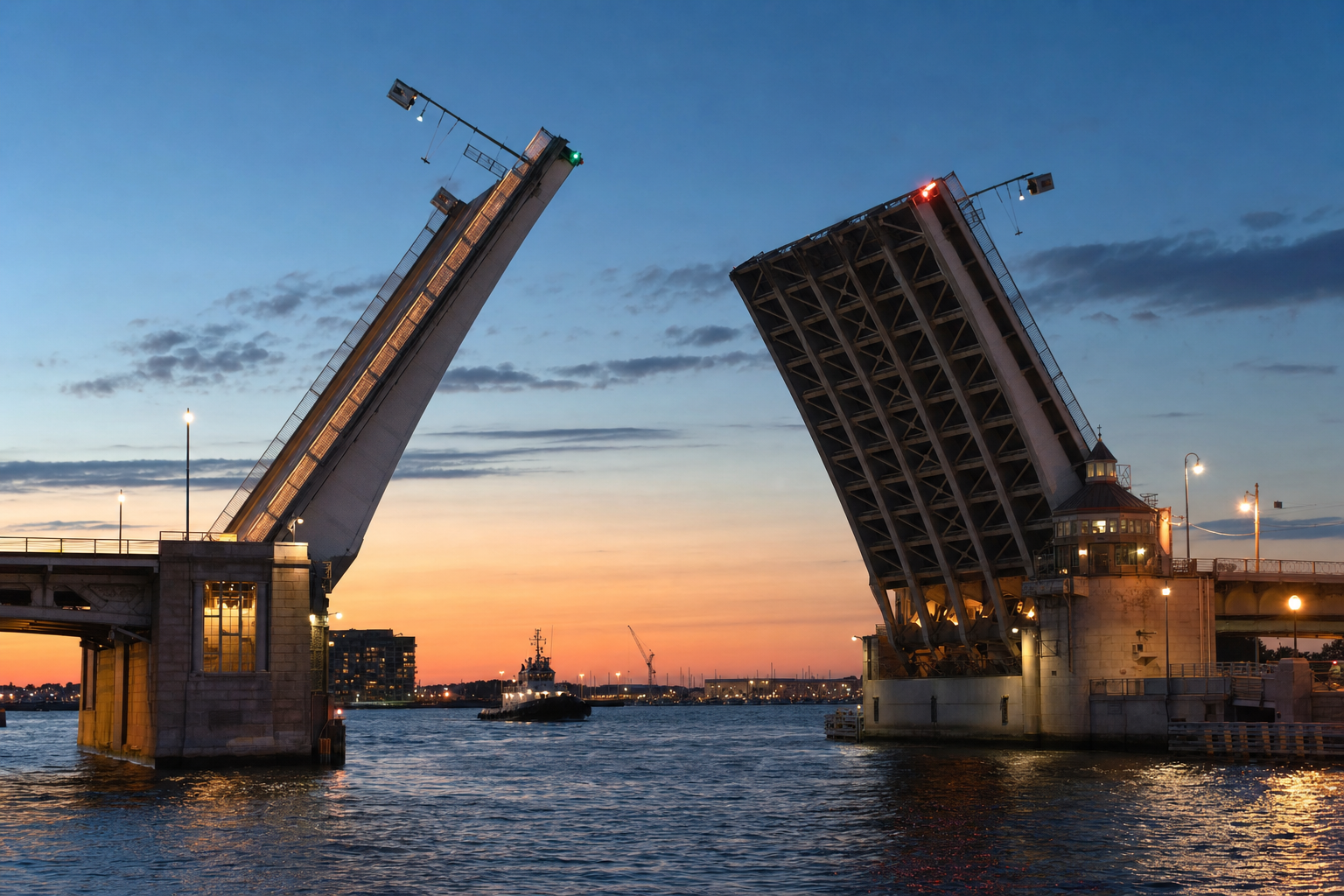
The Choreography of Steel and Water: Understanding Movable Bridge Operations
5 min read
Movable bridges are some of the most fascinating "living" pieces of infrastructure in our modern transport network. Unlike a standard highway overpass or a fixed rail bridge, a movable bridge is a dynamic gatekeeper. It exists at the precise intersection of two vital but conflicting modes of travel: the terrestrial world of cars, trucks, and trains, and the maritime world of tugs, yachts, and barges.
To the driver waiting at a red signal while a massive span of steel swings open, the bridge might seem like a nuisance. To the sea captain navigating a narrow channel, that same bridge is a critical checkpoint. Behind the scenes, the operation of these structures is governed by a complex set of factors designed to ensure safety, efficiency, and fairness for everyone involved.
Understanding why these bridges operate the way they do requires looking at the physical constraints of the bridge, the needs of the local community, and the regulatory environment that oversees them.
The Balancing Act: Why Rules Exist
The primary goal of any rule regarding a movable bridge is to manage the "right of way." Historically, in many parts of the world, maritime traffic has held a privileged position. Because large vessels are harder to stop, turn, or hold in place against currents and winds, they often have the legal right of passage over road traffic.
However, as our cities have grown and road congestion has worsened, the rules have evolved. Modern management is less about who is "more important" and more about finding a mathematical balance. Authorities must weigh the economic impact of a delayed cargo ship against the economic impact of ten thousand commuters sitting in gridlocked traffic.
The Physical Factors That Shape Regulations
Several key physical characteristics determine how a bridge is managed. These aren't just engineering specs; they are the primary drivers for when and why a bridge might open or close.
Vertical and Horizontal Clearance
The most obvious factor is how much space is available when the bridge is closed. "Air draft"—the distance between the water’s surface and the bottom of the bridge—dictates which vessels can pass through without an opening. If a bridge has high vertical clearance, it may rarely need to move, leading to fewer regulations. Conversely, low-lying "bascule" or "swing" bridges require constant management.
Gross Vehicle Weight and Structural Health
For those on the road, the most important factor is often the gross vehicle weight allowed on the span. Movable bridges have complex joints, gears, and locking mechanisms that can be more sensitive to heavy loads than fixed concrete structures. If a bridge is aging or undergoing maintenance, weight limits become stricter, and the frequency of openings might be limited to reduce mechanical wear and tear.
The Mechanism of Movement
The type of bridge also dictates its rules.
- Bascule Bridges: These use a counterweight to "see-saw" the span upward. They are quick but can be affected by high winds.
- Swing Bridges: These rotate on a central pier. They are elegant but often provide a narrower channel for ships, requiring more precise navigation rules.
- Vertical Lift Bridges: These lift the entire span upward like an elevator. These are often used for heavy rail traffic, where keeping the tracks perfectly level is essential.
Navigating the Regulatory Landscape
When we look at the data governing these structures, we find an interesting snapshot of the current regulatory environment. Currently, across our tracked authoritative sources, there are 0 active regulations and 0 permits specifically cataloged in this dataset.
While this might seem surprising given the complexity of bridge operations, it highlights a specific reality of infrastructure management: many of these "rules" are not static laws, but rather dynamic operational agreements. In many jurisdictions, the "rules" of a bridge are handled as local ordinances or maritime notices rather than broad, overarching permits.
This count of zero suggests that the management of movable bridges is often handled at a highly localized level or through real-time operational status updates rather than through a traditional permit-application process for the general public. It emphasizes that for the average traveler or mariner, the "regulation" is often the literal signal light at the bridge itself rather than a piece of paper filed in a central registry.
Key Factors in Operational Decisions
When authorities do set schedules or restrictions, they rely on several core factors:
- Time of Day: Many bridges in urban areas have "closed periods" during morning and evening rush hours. During these windows, the bridge will not open for recreational vessels, prioritizing the flow of commuters.
- Vessel Type: Commercial shipping often gets priority over recreational boats. A barge carrying fuel or raw materials is usually granted passage more readily than a private sailboat, simply due to the economic and safety implications of the cargo.
- Environmental Conditions: High winds, heavy fog, or extreme water levels can trigger temporary "rules" that halt bridge movement. If the wind speed exceeds a certain threshold, the risk of the bridge span acting as a "sail" becomes too high to safely operate the machinery.
- Notice Requirements: Many bridges are not manned 24/7. In these cases, a "notice to open" factor comes into play, requiring mariners to call or radio ahead—sometimes hours in advance—to request a bridge tender.
The Human Element: Safety and Communication
Beyond the steel and the statutes, movable bridges are a human endeavor. Communication is the "soft regulation" that keeps things moving. Marine radios, horn signals (the classic "one long, one short" blast), and digital status boards are the tools used to implement the logic of the bridge.
The goal of providing real-time activity status is to reduce the "surprise factor." When drivers and captains know the status of a crossing, they can make informed decisions. This transparency reduces the likelihood of accidents—such as a vessel approaching too fast or a vehicle trying to "beat the gate"—and helps lower the stress levels of everyone involved in the crossing.
Conclusion
Movable bridges are a testament to our ability to share space. While the current data shows a baseline of zero formal permits or regulations in the primary tracking index, the reality on the ground—and on the water—is one of constant, careful negotiation.
By understanding factors like vertical clearance, gross vehicle weight, and the priority of different transport modes, we can better appreciate the complex dance that happens every time a bridge span begins to rise. These rules, whether they are formal statutes or local operational schedules, exist for a single purpose: to keep our society moving, whether that movement is happening on four wheels or on a hull in the water.