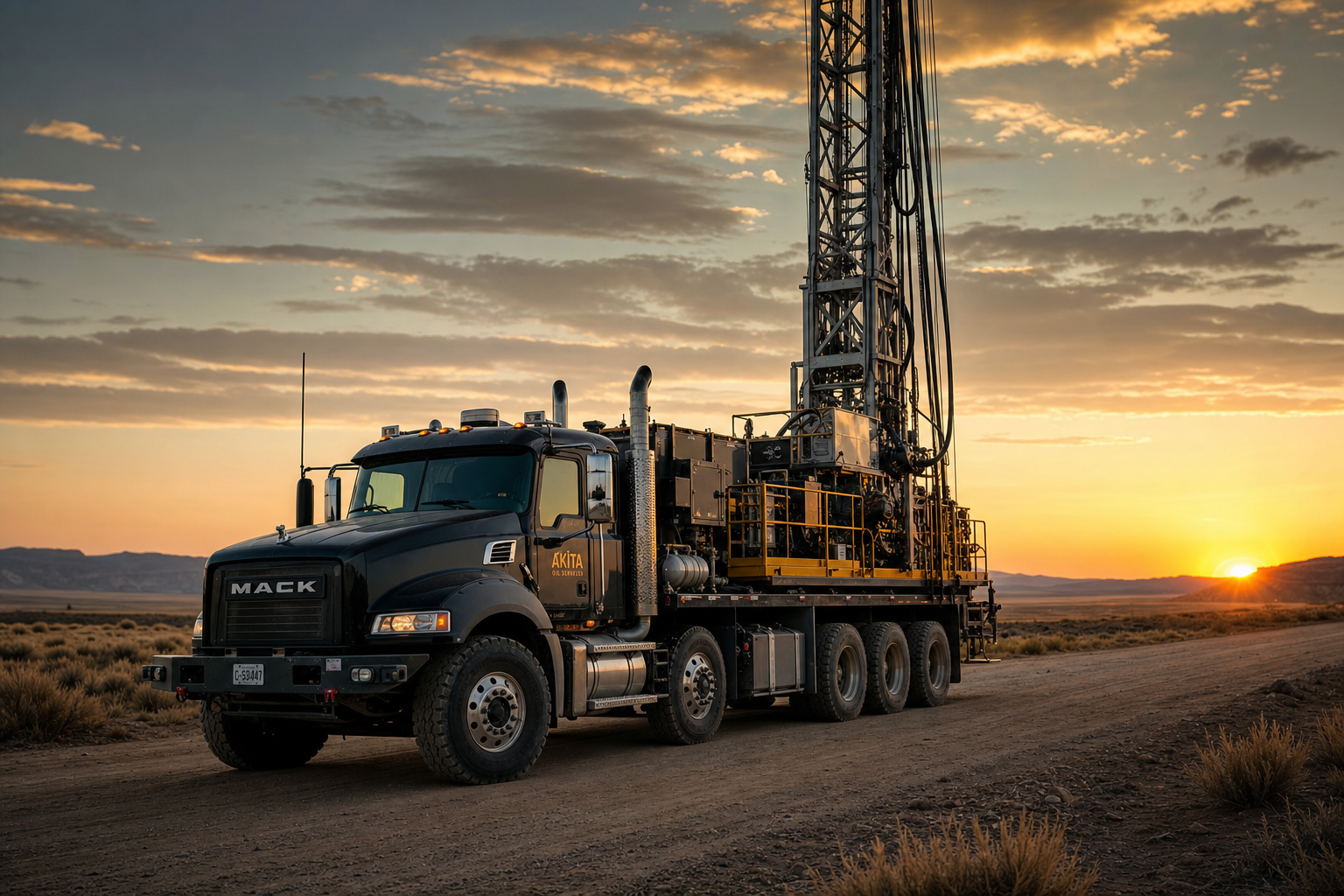
Moving the Oilfield: Understanding the Factors Behind Transport Regulations
5 min read
The oil and gas industry is a feat of engineering, but it is also a massive exercise in logistics. Before a single drop of oil is produced, an army of specialized vehicles must navigate public roads to reach the wellhead. From towering rig-up trucks to high-pressure fracing trailers and versatile oil well servicing units, these vehicles are the literal backbone of petroleum production.
Because of their immense size, specialized functions, and the rugged environments where they operate, these vehicles fall into a unique niche of transport. Understanding why they are regulated—and the factors that determine when a permit is necessary—is essential for anyone involved in energy production or heavy logistics.
The Specialized Fleet of the Oilfield
To understand the regulatory landscape, one must first understand the equipment. We are not talking about standard long-haul semi-trucks. The vehicles used in oil well and fracing transport are often "mobile machinery" or highly specialized configurations designed for a single purpose.
Oil Well Servicing Units
These are self-propelled vehicles equipped with masts, winches, and various tools used to maintain or "workover" an existing well. They are heavy, often top-heavy, and move relatively infrequently compared to delivery trucks.
Fracing Trailers
Hydraulic fracturing requires massive amounts of pressure. Fracing trailers house the high-horsepower pumps and blenders necessary for the job. These units are often at the absolute limit of what road infrastructure can support in terms of weight and dimensions.
Rig-Up Trucks
These are the heavy-lifters of the oilfield. Equipped with large winches and "gin poles," they are designed to lift, move, and assemble the components of a drilling rig. Their build is focused on torque and lifting capacity rather than aerodynamic efficiency or highway speed.
Why Do Regulations Exist?
Regulations and permit requirements for these vehicles are not meant to be hurdles; they are designed as protective measures. There are three primary reasons why a government body or transport authority monitors these movements.
- Infrastructure Preservation: Roads and bridges have a finite lifespan, which is accelerated by heavy loads. A single overweight fracing trailer can cause as much wear on a rural road as thousands of passenger cars. Permits help authorities steer these heavy loads toward roads that can handle the stress.
- Public Safety: Because these units are often wider, taller, and slower than standard traffic, they pose unique risks. Regulations ensure that operators use escort vehicles, proper lighting, and designated routes to minimize the chance of collisions.
- Traffic Management: Many oilfields are located in remote areas with narrow, winding roads. Coordination through permits prevents "logjams" where two oversized loads might meet on a path where they cannot pass one another.
Key Factors That Shape Transport Rules
When determining whether a specific movement requires a permit or falls under a specific regulation, authorities look at several physical and operational factors. In everyday language, these are the "triggers" for oversight.
Gross Vehicle Weight
This is perhaps the most significant factor. Most standard roads are designed for a specific maximum weight. When an oil well servicing unit exceeds this limit, it enters the realm of "overweight" permits. Authorities look at the total weight of the vehicle, including all permanently mounted equipment and fluids.
Axle Weight and Distribution
It isn't just about the total weight; it is about how that weight hits the pavement. A very heavy fracing trailer might be allowed on a road if it has enough axles to spread the load. If the weight per axle is too high, it can crush the road sub-base, leading to potholes and structural failure.
Physical Dimensions (Width and Height)
Rig-up trucks and fracing units are often "oversize." A standard lane is typically 12 feet wide. If a piece of equipment is wider than that, it occupies more than its fair share of the road. Similarly, height is a critical factor for clearing overpasses and power lines.
Route Complexity and "The Last Mile"
Regulations often change based on where the vehicle is traveling. A unit might be perfectly legal on a major interstate but require a special permit the moment it turns onto a county-maintained gravel road. The "last mile" to the well site is often the most regulated portion of the journey because the infrastructure is the most vulnerable.
A Note on the Current Data
In analyzing the specific category of "Oil Well and Fracing Transport," our current comprehensive dataset shows a total of 0 regulations and 0 permits drawn from 0 authoritative sources.
While this might seem surprising given the complexity described above, it highlights a specific reality of transport law: specialization. In many jurisdictions, these vehicles do not have their own "bespoke" category of permits. Instead, they are governed by broader, "catch-all" regulations for oversize and overweight loads.
Rather than having a specific "Fracing Trailer Permit," an operator might instead apply for a "Superload Permit" or a "Non-Divisible Overweight Permit." The lack of specific category-level entries in this snapshot suggests that the rules governing these vehicles are often integrated into the wider fabric of heavy transport and infrastructure law rather than existing as standalone industry-specific statutes.
The Practical Impact of Oversight
For the people operating these vehicles, the regulatory framework dictates their daily schedule. A permit might restrict a rig-up truck to traveling only during daylight hours or forbid travel during holidays when traffic is high.
Furthermore, the "non-divisible" nature of this equipment is a major factor. In general transport, if a truck is too heavy, you simply take some of the cargo off. But you cannot "take a piece off" a fracing pump or a servicing mast without rendering it useless. Because these loads are non-divisible, the regulations are often more flexible regarding weight, provided the operator follows a very specific, pre-approved route.
Summary and Outlook
The transport of oil well and fracing equipment is a dance between industrial necessity and public responsibility. While the equipment is essential for energy production, its impact on roads and safety requires constant monitoring.
Even when specific "oilfield-only" permits aren't the primary tool—as evidenced by the zero counts in the current niche dataset—the broader principles of gross vehicle weight, axle distribution, and dimensional limits remains the standard. By understanding these factors, operators and the public can better appreciate the massive logistical effort required to keep the energy industry moving safely and efficiently.
As technology evolves, we may see "smarter" regulations, such as real-time weight monitoring or GPS-based routing that adjusts for weather and road conditions. For now, the focus remains on the fundamentals: protecting the roads we all share while moving the heavy machinery that powers our world.