The Role and Regulation of Escort Vehicles in Heavy Haul Transport
5 min read
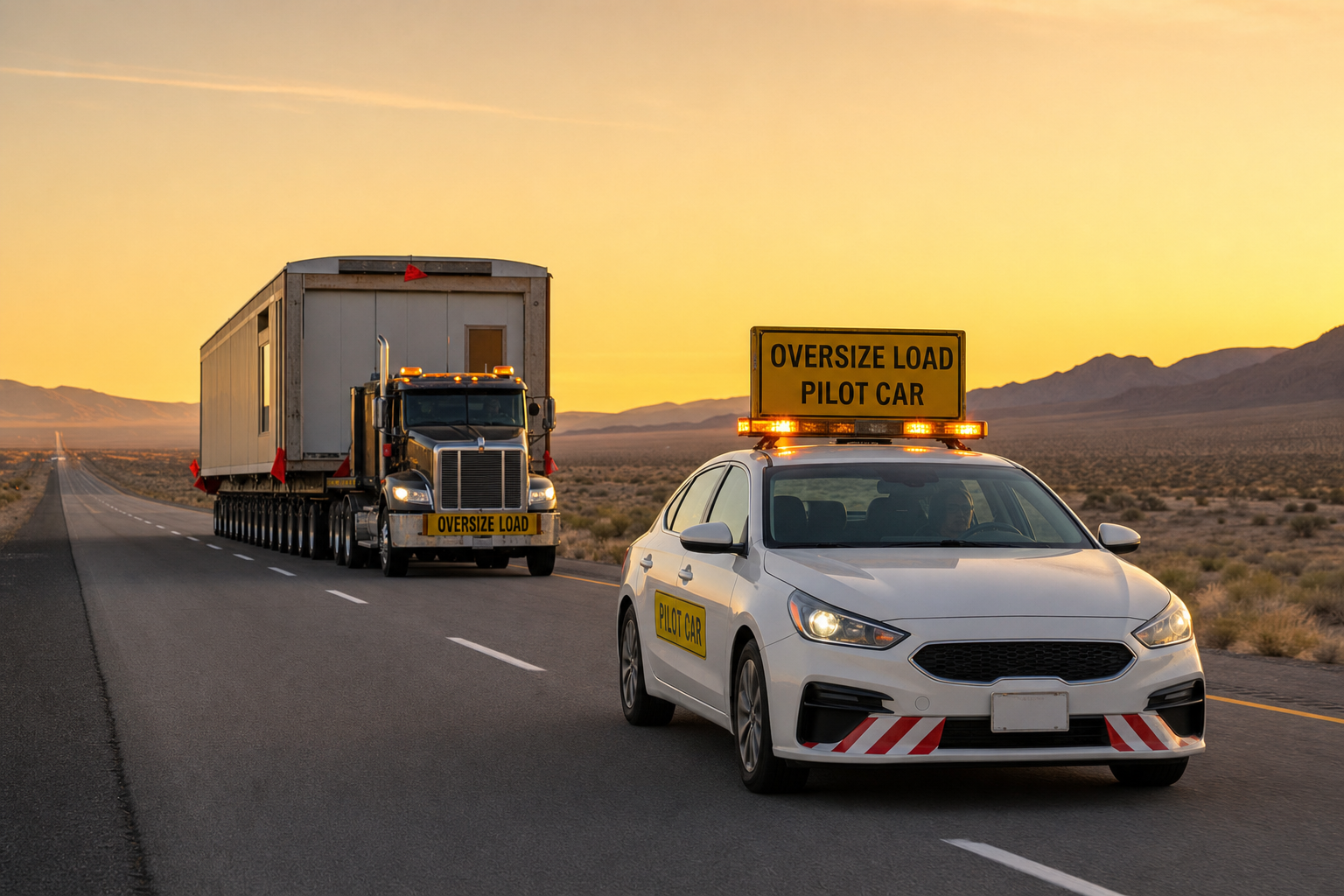
When a massive piece of machinery or a pre-built home travels down a public highway, it is rarely a solitary endeavor. You have likely seen the accompanying vehicles—often pickup trucks outfitted with amber lights, "Oversize Load" banners, and occasionally long, flexible poles reaching into the air. These are escort vehicles, also known as pilot cars. Their presence is not merely a courtesy; it is a highly regulated safety requirement designed to protect the driver, the public, and the infrastructure.
Understanding the landscape of these requirements involves navigating a complex web of rules. Across North America, there are at least 491 distinct rules governing escorts and pilot cars, drawn from 73 different authoritative sources. These rules are divided into 172 formal regulations and 319 specific permit conditions. The vast majority of these—456 to be exact—are "must" requirements, meaning they are mandatory obligations rather than mere suggestions.
Why Escorts are Required
The primary purpose of an escort vehicle is to act as a mobile safety zone. Whether they are positioned in front of a load (a lead or front escort) or behind it (a chase or rear escort), their job is to warn oncoming traffic, help the truck driver navigate tight turns, and ensure that the oversized load does not strike bridges, wires, or other vehicles.
The necessity of an escort is determined by several physical and environmental factors. Because highways are built for standard-sized vehicles, anything that exceeds those dimensions risks disrupting the flow of traffic or damaging property. This is why 456 of the rules identified are binding requirements; the risks associated with moving "super loads" or extremely wide objects are too high to leave to chance.
Primary Factors That Trigger Escort Rules
While every jurisdiction has its own nuances, several core factors consistently determine when you need an escort and how many you must have.
1. Vehicle and Load Dimensions
By far the most common reason for a pilot car is the width of the load. The total width of the vehicle and its cargo appears in 165 different rules as a primary trigger. When a load is wide enough to encroach on an adjacent lane or a shoulder, a pilot car is almost always required to warn other motorists.
Length and height are also critical:
- Total Length: The overall length of the vehicle and load determines the need for escorts in 82 rules. This is particularly important for navigating intersections and curves.
- Overall Height: Appearing in 58 rules, the height of the load often dictates the use of a "high pole" escort. This vehicle travels ahead with a vertical pole set at the load's height to ensure it can clear overpasses and utility lines.
- Overhang: If a load extends significantly beyond the front or rear bumper, it creates a "swing" hazard. Specific rules apply when the rear overhang is particularly long, as the back of the trailer will swing wide during turns.
2. Road Configuration and Type
The environment where the travel occurs is just as important as the size of the load. Regulations often change based on the type of road being traveled. For instance, a two-lane undivided highway presents significantly more risk for a wide load than a multi-lane divided interstate.
In some areas, like Idaho, officials use a color-coded classification map to determine requirements. These maps categorize routes based on their difficulty and safety profile, with specific colors triggering different levels of escort support. Similarly, traveling through a designated business district or an urbanized area often requires extra precautions compared to rural stretches.
3. Timing and Visibility
When a load moves also changes the rules. Darkness—defined as the period from one-half hour after sunset to one-half hour before sunrise—triggers additional requirements in 13 rules. Some loads are restricted to daylight hours only to ensure they are visible to the public. Statutory holidays and the days preceding them can also affect whether a load is allowed on the road at all, as high traffic volumes during these times make moving oversized loads more dangerous.
4. Weight and Infrastructure Protection
While escorts are usually associated with size, weight plays a role too. The total gross weight of the load and the weight borne by specific axle groups (such as tandem or tridum groups) are factors in 22 rules. For "superloads"—massive shipments that require special engineering reviews—escorts may be required to manage traffic while the truck crosses a bridge at a "crawl speed" or occupies the center of the bridge to distribute weight safely.
Types of Escort Services
Depending on the complexity of the move, a transport company may need different types of support:
- Lead/Front Escorts: Warn oncoming traffic on two-lane roads.
- Chase/Rear Escorts: Warn traffic approaching from behind, especially on multi-lane highways.
- High Pole Vehicles: Specifically equipped to check vertical clearance.
- Police Escorts: In certain high-risk scenarios, such as when a load must travel against the flow of traffic or through a major metropolitan intersection, law enforcement may be required to take over traffic control.
- Steer Cars: For exceptionally long loads, a rear escort driver may actually help steer the back of the trailer.
Regional Variations
The regulatory burden is not distributed evenly. For example, the United States has 28 regulations and 37 permit-related rules in this category. In Canada, Manitoba is particularly active with 23 regulations and 10 permit requirements. Other regions like Alberta, British Columbia, and Quebec also maintain robust systems of rules to manage their unique geographies.
In some states, such as Indiana and Michigan, there is a nearly equal focus on permanent regulations and individual permit requirements. In others, like Pennsylvania or Saskatchewan, the requirements are almost exclusively found within the permits themselves rather than in general statutes.
Professional Standards for Escort Operators
Being a pilot car operator is a professional role that requires more than just a truck and a sign. Rules often specify the level of insurance a provider must carry, ranging from general liability to specific professional coverage.
Furthermore, many jurisdictions require operators to hold specific certifications, such as the Certified Escort Vehicle Operator (CEVO) or Certified Safety Escort (CSE) designations. These programs ensure the operator knows how to communicate with the truck driver, how to handle emergency situations, and how to properly use equipment like flags, banners, and CB radios.
Summary
The 491 rules governing escorts and pilot cars exist to create a predictable environment on the road. By factoring in the width, length, height, and weight of a load, along with the specific road configuration and time of day, transport authorities aim to minimize the "friction" caused by oversized shipments. While these rules can seem dense, they are the essential framework that allows our modern infrastructure—from wind turbine blades to modular homes—to move safely across the continent. Regardless of whether you are a driver, an operator, or a curious motorist, these regulations serve as the silent partners in every successful heavy haul.