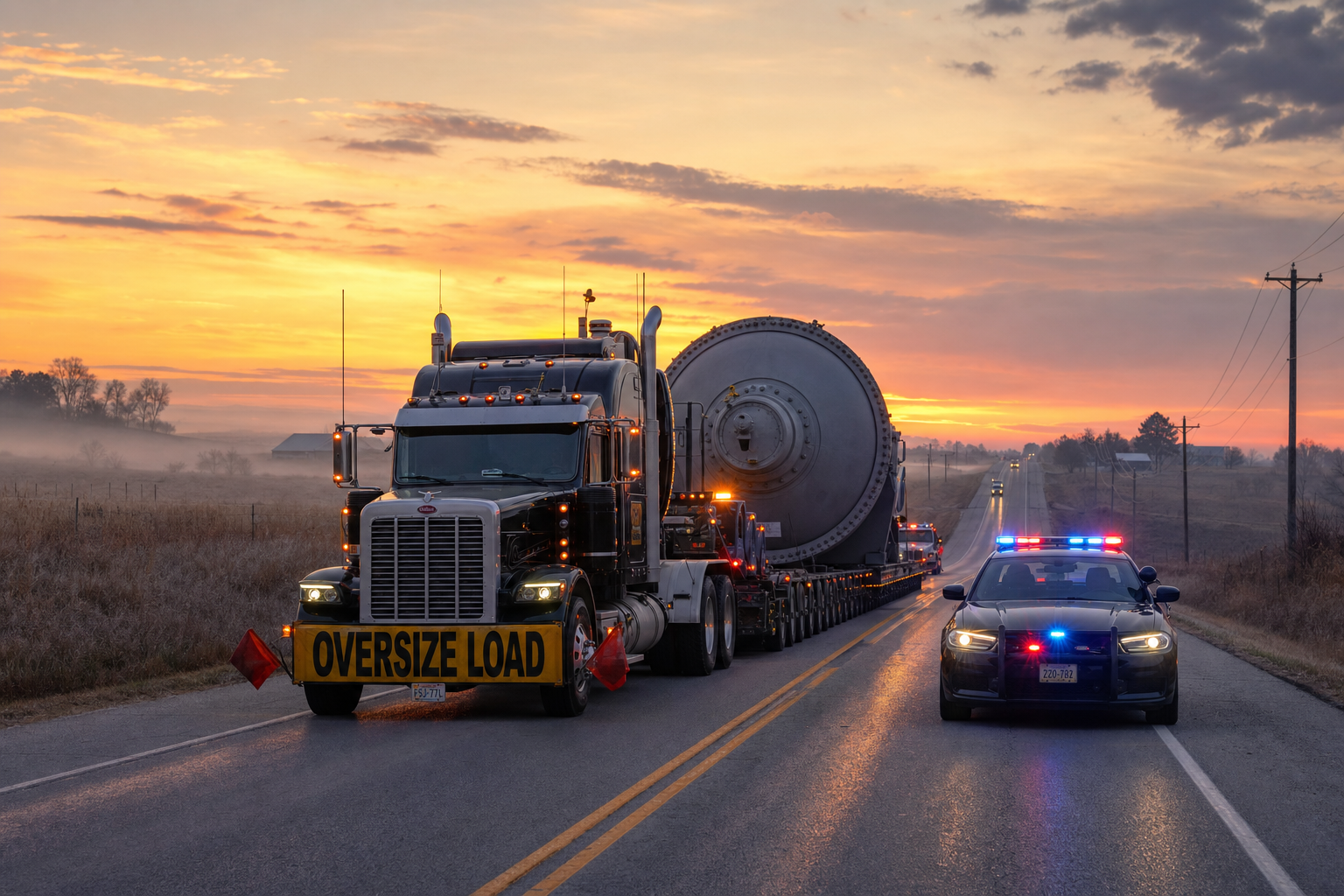
Navigating the Requirements for Police Escorts in Oversize Transport
5 min read
In the world of logistics and infrastructure, most people are familiar with "oversize load" signs and the yellow pilot cars that accompany large trucks. However, when a shipment reaches extreme proportions—such as a massive electrical transformer or a pre-fabricated bridge section—standard pilot cars are often not enough. This is where police escorts enter the picture.
Understanding why and when law enforcement is required to shepherd a load is essential for regional planning and public safety. Across four authoritative jurisdictions, including Tennessee, Maine, and Québec, there are 11 distinct rules that dictate these operations. These rules are split between seven formal regulations and four permit-based requirements.
By looking at the data behind these rules, we can better understand the delicate balance between moving essential goods and keeping the traveling public safe.
The Mandate: Why Law Enforcement?
Safety is the primary driver behind police involvement. While civilian pilot car drivers are highly trained, they do not possess the authority to stop traffic at intersections, direct vehicles against the flow of traffic, or issue citations. When a load is so large that it must occupy multiple lanes or travel on the wrong side of the road to clear an obstacle, the legal authority of a police officer is required.
The level of obligation for these rules varies. Out of the 11 rules identified:
- 6 are mandatory ("must"): These are hard lines where transport cannot proceed without a badge present.
- 4 are discretionary ("may"): These allow transportation departments or law enforcement agencies to decide if an escort is necessary based on specific route conditions.
- 1 is a recommendation ("should"): This suggests a best practice for safety that may not be strictly enforced but is highly encouraged.
Critical Dimensions and Thresholds
The physical size of the vehicle and its load is the most common trigger for police involvement. Regulations often focus on three primary metrics: total width, overall height, and overall length.
For example, two of the major rules currently in place are triggered specifically by the total width of the vehicle and its load. When a shipment exceeds a certain width—often 16 to 18 feet depending on the region—it begins to encroach on the "safety cushion" of the adjacent lane. In these cases, a police escort provides a level of "command and control" that a civilian vehicle simply cannot.
Similarly, the overall length and height play a role. A load that is 200 feet long cannot navigate a standard turn without swinging into oncoming traffic. Law enforcement is there to hold back traffic and ensure the driver has the space needed to complete the maneuver without causing a collision.
The Logistics of Scheduling and Notice
One of the most complex aspects of police escorts is the administrative lead time. Police officers are not just there to drive; they are there to manage a high-risk event. Because of this, the required advance notice time before the scheduled service is a factor in three of the rules we examined.
Agencies often require several days or even weeks of notice to coordinate staffing. This isn't just about finding an available car; it’s about ensuring the officers are briefed on the route and the specific hazards of the load. Furthermore, the duration required for police officers to perform pre-departure checks appears in two of the rules. These checks are vital; the officer must verify that the permits are in order and that the vehicle matches the description provided before the wheels start turning.
Life happens, and plans change. One rule specifically addresses the required advance notice time to cancel a service without penalty. This protects the public's resources, ensuring that officers aren't pulled away from other duties for a job that isn't ready to move.
Where and When: The Influence of Geography and Time
The environment where the transport occurs is just as important as the size of the load. The classification of the highway being traveled is a key factor in two of the rules. A "super-load" moving on a four-lane divided interstate may only require civilian pilot cars, whereas the same load moving on a narrow, two-lane state highway might require a full police detail because there is no room for other drivers to pass safely.
Timing also plays a significant role. Authorities often use the start hour and end hour of the escort operation to determine coverage requirements. Some regions may prohibit these moves during peak commuting hours or at night, while others may actually require night moves to minimize the impact on daytime traffic. These specific start and end times help agencies determine if a single shift of officers is sufficient or if a relay of multiple crews will be needed for a long-distance haul.
A Regional Comparison
The way these rules are codified varies significantly by region. Looking at the breakdown of our four source jurisdictions:
- Québec/Quebec: This region relies heavily on formal regulations, with a total of five regulations (three under "Québec" and two under "Quebec") and zero permits listed. This suggests a highly standardized, law-based approach where requirements are clearly defined in the provincial code.
- Tennessee: In contrast, Tennessee shows four permits and zero regulations. This indicates a more flexible, case-by-case system where the requirements for a police escort are tied specifically to the individual permit issued for a particular load.
- Maine: Maine sits in the middle with two regulations and no permits, emphasizing a clear, rule-based framework for transport through the state.
Conclusion
Police escorts are a specialized necessity for the most challenging transport projects. Whether it’s managing the width of a massive industrial component or navigating a 200-foot trailer through a small town, law enforcement provides the authority and safety oversight that keeps our roads functional.
By understanding the factors—from highway classification to the necessity of pre-departure checks—shippers and the public can better appreciate the massive effort required to move the world’s largest objects safely. While the "musts" and "mays" of the law can be complex, they exist to ensure that when a massive load takes to the road, everyone gets home safely.