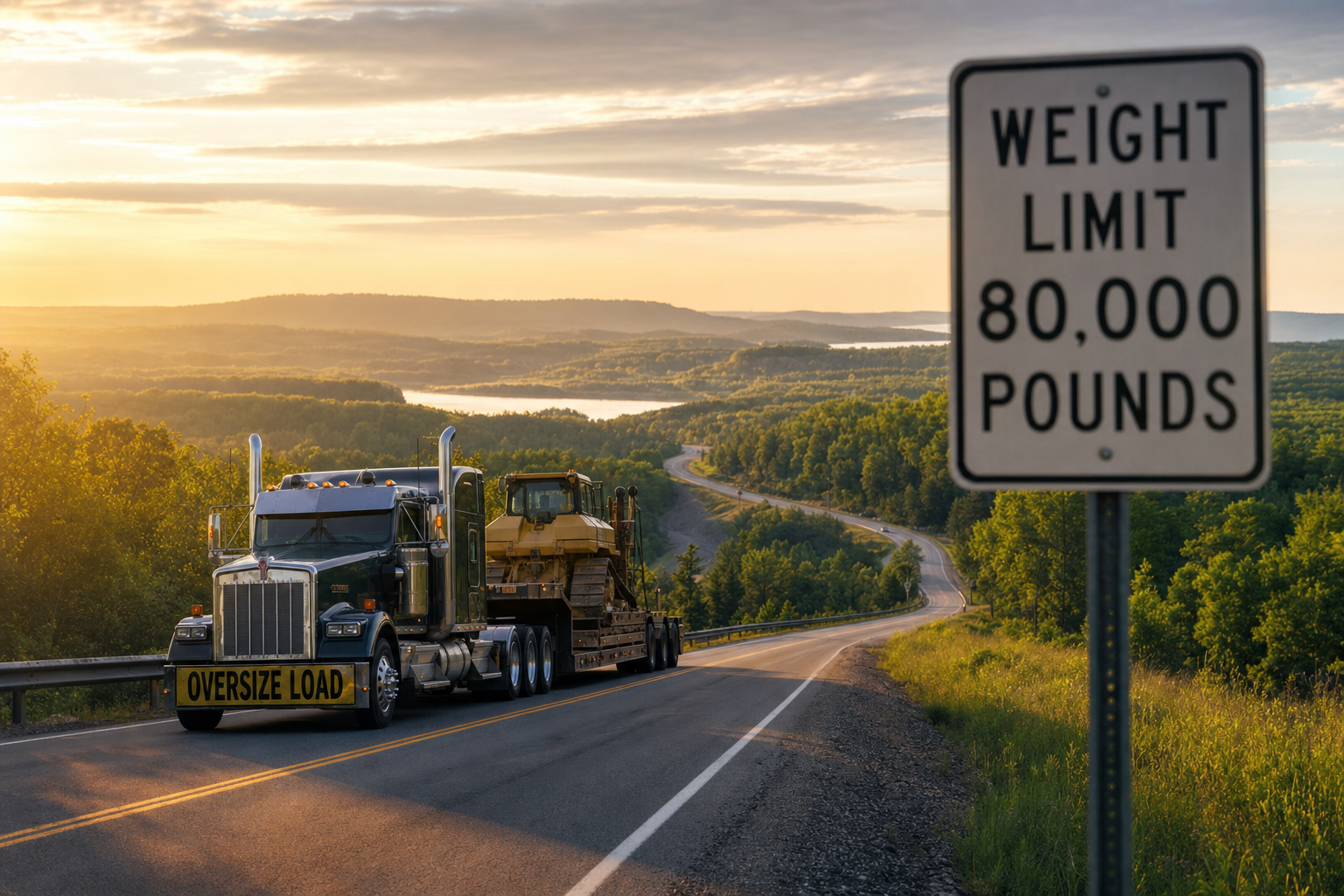
Understanding Posted Highway Operations: Navigating Weight Limits and Restricted Routes
5 min read
When you are driving down a secondary highway or a rural road, you have likely seen them: small, rectangular signs perched beneath the standard route markers. They might say "Weight Limit 10 Tons," "No Thru Trucks," or "Axle Limit 5 Tons." In the industry, these are known as posted highways.
Operating a vehicle on these roads isn't just a matter of following the GPS; it is a complex intersection of civil engineering, seasonal weather patterns, and local governance. Understanding the factors that lead a road to be "posted" is essential for anyone involved in logistics, construction, or heavy hauling. While some regulations are uniform across a state, posted highway operations are unique because they are often highly localized and situational.
The Purpose of the Post: Why Rules Exist
At its core, every road is a piece of engineered equipment with a finite lifespan. Highway departments and local municipalities post restrictions for one primary reason: preservation.
Roads and bridges are designed to withstand specific amounts of stress. When a vehicle exceeds that stress level, it doesn't just cause "wear and tear"—it can cause structural failure. A bridge built in the 1940s may be perfectly safe for thousands of cars, yet a single modern semi-truck carrying heavy machinery could stress the steel girders beyond their "elastic limit," causing permanent deformation.
By posting a highway, authorities are essentially setting a boundary to ensure the infrastructure lasts its intended thirty or fifty years. Without these rules, the cost of road repair would skyrocket, and the safety of the general public would be compromised.
Key Factors Shaping Restrictions
When an engineer decides to post a road, they aren't choosing numbers at random. Several concrete factors determine exactly what kind of traffic is allowed and when.
Gross Vehicle Weight
The most common factor is the total weight of the vehicle and its load. This is the simplest metric for a driver to understand. If a bridge is rated for 15 tons and your truck weighs 18 tons, the math is straightforward. Gross weight restrictions are often used for bridges or old "chip-seal" roads that lack a deep, reinforced base.
Axle Weight and Distribution
Sometimes, the total weight isn't the problem; it’s how that weight touches the ground. A very heavy vehicle with many axles might actually be "gentler" on a road than a slightly lighter vehicle with only two axles.
Think of it like walking on thin ice: you are safer laying flat (distributing your weight) than standing on your tiptoes (concentrating it). Many posted highways focus on axle weight limits to prevent the "punch-through" effect that shatters pavement.
Seasonal Sensitivity (The "Frost Law" Factor)
In many parts of the country, the most restrictive rules appear in the spring. As the ground thaws, water gets trapped between the melting surface and the still-frozen layers underneath. During this "spring thaw," the road base becomes saturated and soft. A truck that the road could easily support in the dead of winter or the heat of summer might sink right through the asphalt in March. This is why many posted operations are temporary, appearing only during specific months of the year.
Bridge Health and Geometry
Bridges are the most vulnerable links in the highway chain. Beyond weight, some roads are posted because of the bridge's physical dimensions. Low clearances or narrow lanes might trigger a "restriction" that isn't about weight at all, but about the safe passage of oversized loads.
The Regulatory Landscape: A Patchwork System
A look at the current data reveals a fascinating trend in how these operations are managed. According to our current survey of authoritative sources, there are 0 regulations and 0 permits listed at a centralized, aggregate level for this specific category.
This "zero" does not mean that there are no rules. Rather, it highlights a critical reality of posted highway operations: they are almost entirely decentralized. Unlike interstate commerce or standard overweight permits—which are often managed through massive state databases—posted highway authorizations are usually the domain of the local county engineer, the township supervisor, or the municipal public works department.
Why the Numbers Show "Zero"
In the world of regulatory data, "zero" often indicates that the power has been devolved to the lowest level of government. While a state may have a general law allowing towns to post roads, the actual act of posting a specific weight limit on "Maple Lane" is a local decision.
This means there isn't a single, monolithic permit you can download to cover every posted road in a region. Instead, an operator often has to seek a specific "Letter of Authorization" or a localized permit from the specific entity that owns the road. For the informed operator, this means that research must happen at the local level, rather than relying on a federal or state-wide manual.
When Do the Rules Apply?
Determining when you need an authorization to bypass a posting is generally based on the "Strict Necessity" vs. "Alternative Route" test.
- Local Delivery and Residential Access: Most posted highways include an exemption for "local deliveries." If you are delivering heating oil to a home on a posted road, or if a garbage truck is making its rounds, these are usually permitted because there is no other way to provide the service.
- Point of Origin/Destination: If your home base or your job site is located on a restricted road, you can often apply for a specific permit. The authorities may require you to post a "bond"—a sum of money held in escrow to pay for any damage your heavy equipment might cause to the road.
- Alternative Routes: If a posted bridge can be avoided by taking a ten-mile detour on a major highway, authorities are unlikely to grant a permit to cross the restricted bridge. The goal of the regulation is to move the heavy weight to the infrastructure best equipped to handle it.
Navigating the Process
Because these rules are so localized, the "permit" process for a posted highway is often more of a conversation than a digital application. It involves:
- Communication: Calling the county road commission or the town hall to explain the necessity of the trip.
- Verification: Proving the actual weight and axle configuration of the vehicle.
- Infrastructure Analysis: Sometimes, the authority will ask for a "route survey" to ensure the vehicle can physically make the turns and clear the bridges.
- Mitigation: In some cases, you might be allowed to use a posted road only at certain times of day (like when the ground is still frozen in the early morning) or at reduced speeds.
Summary
Posted highway operations represent the "last mile" of infrastructure protection. They are the rules that keep our neighborhood streets from crumbling and our historic bridges from collapsing.
While the lack of centralized regulations or permits in high-level databases suggests a lack of oversight, the reality is the opposite: it is a highly specialized, locally-controlled environment. For the driver or fleet manager, success in this category isn't just about knowing the law—it's about understanding the physical limits of the road and working with local stewards to move heavy loads safely and responsibly. Information is the best tool for compliance; knowing why a road is posted is the first step toward finding a legal way to get where you need to go.