Moving the Heavy and the Hard-to-Handle: Understanding Special Hauling Regulations
5 min read
In the world of logistics and transportation, most goods move in standard containers or on the backs of common flatbed trailers. However, there is a significant category of cargo that defies standard dimensions and weights. Whether it is a sixty-foot utility pole destined for a new power line, a massive combine harvester moving between fields, or a towering load of raw timber from a forest, these items fall into the category of "Special Hauling."
Special hauling is a specialized subset of the broader Oversize/Overweight (OS/OW) regulatory framework. Because these commodities—primarily forest products, farm equipment, and utility poles—are essential to the economy but pose unique risks to infrastructure and road safety, they are governed by a distinct logic. Understanding this logic requires looking past the paperwork to the physical realities of the road.
The Foundation of Special Hauling Rules
At its core, the regulation of special hauling is a balancing act. On one side is the economic necessity of moving raw materials and heavy machinery efficiently. On the other side is the physical limit of our infrastructure. Roads and bridges are engineered to withstand specific amounts of pressure, and lanes are designed for vehicles of a certain width.
When we examine the data for this specific category, we find a unique starting point: a current count of zero regulations and zero permits drawn from zero authoritative sources. While this suggests a clean slate in this specific data snapshot, it highlights an important truth about special hauling: these rules are often highly localized, seasonal, or dictated by specific regional industries rather than a single, universal federal standard. The absence of specific entries in a database doesn't mean the rules don't exist; rather, it often means the rules are nested within broader transportation laws or managed through informal, long-standing local "allowances."
Key Factors: Weight and Distribution
The most critical factor in any hauling regulation is weight. However, regulators do not just look at the total mass of the truck. They break it down into two primary categories:
Gross Vehicle Weight
This is the total weight of the truck, the trailer, and the load combined. Every bridge has a maximum capacity, and exceeding this gross vehicle weight can lead to structural fatigue or, in extreme cases, immediate failure. Special hauling often involves "indivisible loads"—items like a single large log or a piece of heavy farm machinery that cannot be easily taken apart to reduce weight.
Axle Weight
Perhaps more important than the total weight is how that weight is distributed. Axle weight refers to the amount of pressure a single set of tires puts on the pavement. A very heavy load spread across many axles might be safer for a road than a lighter load concentrated on just two axles. This is why you will often see specialized trailers with extra "jeep" or "booster" axles when transporting heavy utility equipment or large forest products.
Dimensions and the "Overhang" Challenge
Beyond weight, the physical size of the load dictates how and when it can move. For the commodities in this category, "length" and "width" are the primary concerns.
- Width: Farm equipment is notoriously wide. A combine harvester might take up a lane and a half. Regulations for these items often focus on visibility—requiring flashing lights, "Oversize Load" banners, or escort vehicles to warn oncoming traffic.
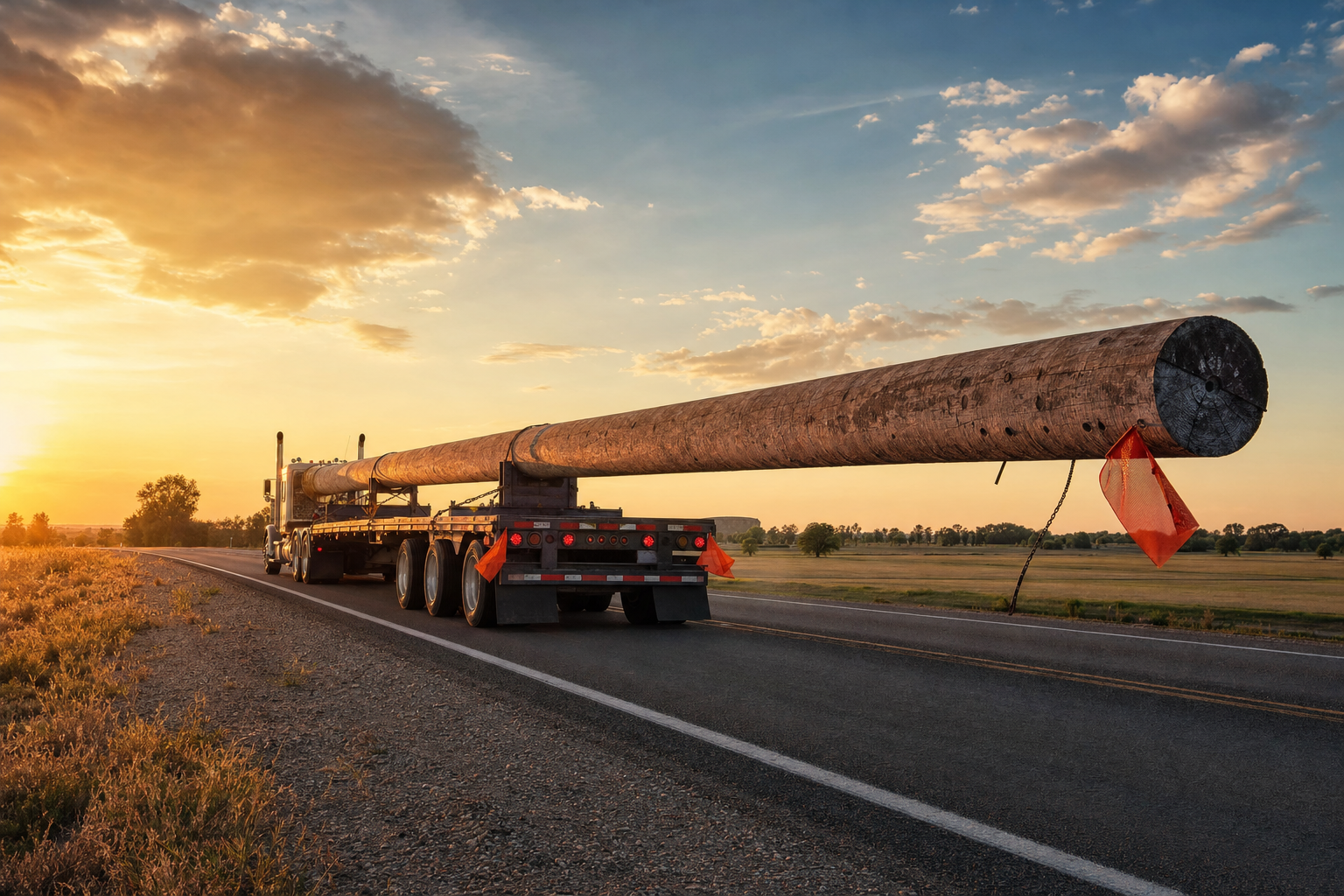
- Length and Overhang: Utility poles and logs present a "length" challenge. When a utility pole extends significantly past the rear of the trailer, it creates a "swing radius" that can be dangerous during turns. Rules for these loads typically dictate how much "overhang" is allowed before a red flag or a light must be attached to the end of the load.
Why Commodity Matters: Forest, Farm, and Utility
The reason "Special Hauling" exists as a separate category is that these specific goods behave differently than a box of electronics.
Forest Products
Moving logs and pulpwood is often a "first-mile" challenge. These trucks travel on unpaved forest roads before hitting the highway. Because the weight of raw timber can change based on moisture content (green wood is significantly heavier than dry wood), some regions allow for weight tolerances that wouldn't apply to a truck carrying steel beams.
Farm Products and Equipment
Agriculture is the backbone of the economy, but it is also seasonal. Many jurisdictions provide "seasonal waivers" for farm equipment. During harvest or planting seasons, the rules might be relaxed to allow farmers to move machinery between fields without a separate permit for every trip, provided they stay within a certain radius or follow specific safety marking protocols.
Utility Poles
Unlike a private shipment of goods, utility poles are often moved during emergencies, such as after a major storm. Because restoring power is a matter of public safety, utility hauling often enjoys "emergency provisions" that allow for faster permitting or exemptions from certain travel-time restrictions that would otherwise apply to oversize loads.
Navigating the Permit Landscape
While our current data snapshot shows zero active permits in this specific set, the process of obtaining a permit in the real world is determined by the "exception" rule. Generally, if a load exceeds the standard legal limits for a highway—often 80,000 pounds for gross vehicle weight or 8.5 feet in width—a permit becomes necessary.
The permit is essentially a contract between the hauler and the government. The government grants permission to use the road, and in exchange, the hauler agrees to follow a specific route, travel during specific hours (often avoiding sunrise or sunset), and use specific safety equipment.
Conclusion: A System of Safety
Special hauling regulations may seem complex, but they are built on the simple goal of keeping the "veins" of our economy—our roads—functioning and safe. Whether the load is a harvest of timber from the Pacific Northwest or a fleet of tractors in the Midwest, the rules are shaped by the physical reality of the cargo.
By focusing on factors like gross vehicle weight, axle distribution, and equipment dimensions, authorities ensure that the heavy lifting required by our society doesn't come at the expense of our shared infrastructure. For those observing this field, the "zero" in a regulatory count is rarely a sign of a lack of oversight; rather, it is often a sign of a highly specialized system where the rules are as unique as the loads themselves.