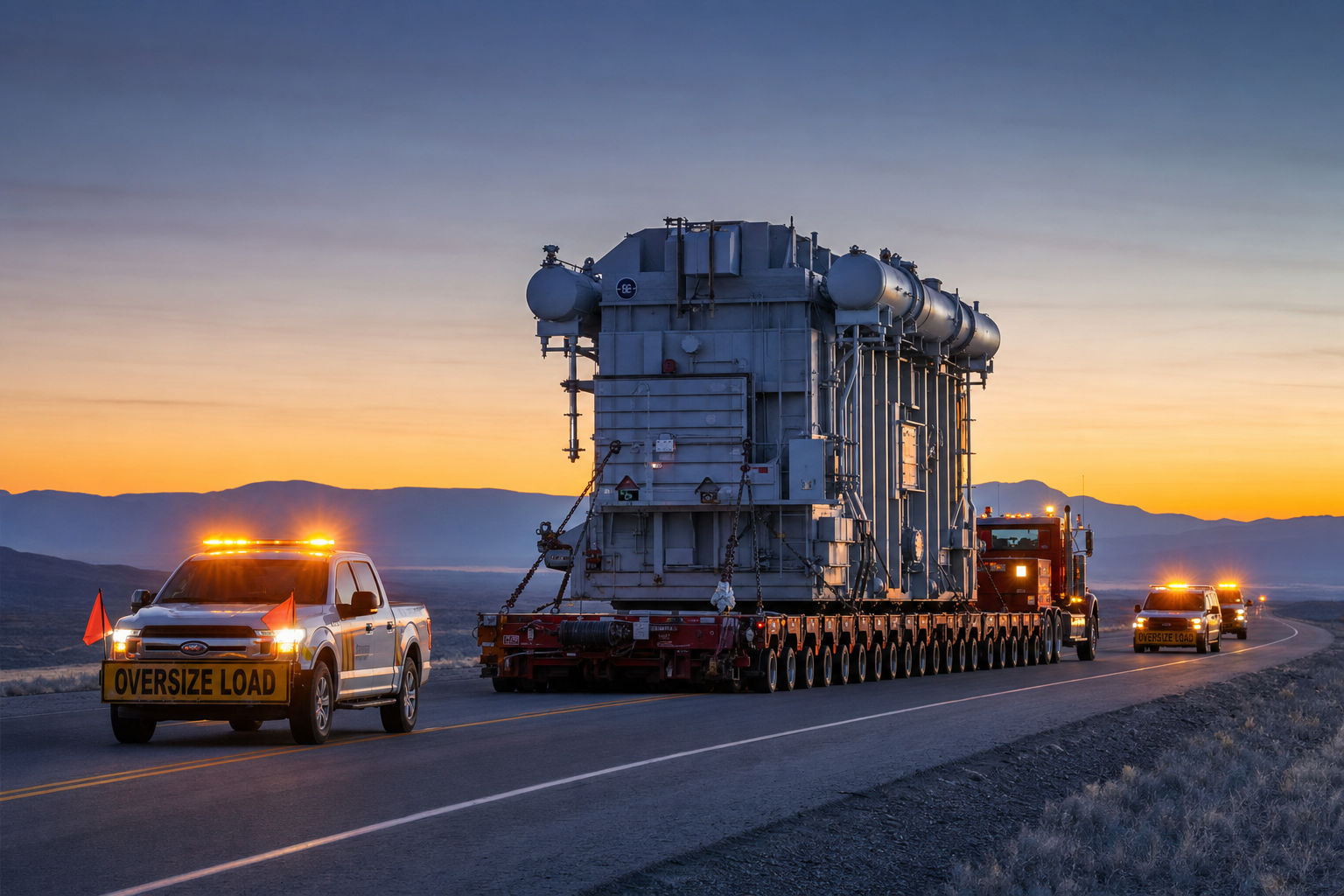
Understanding Superloads: The Engineering and Regulation of Extreme Transport
4 min read
When a massive industrial boiler, a bridge girder, or a towering electrical transformer needs to move across the country, it doesn't just pull onto the highway like a standard semi-truck. These shipments fall into the category of "superloads"—loads so heavy or large that they exceed the standard limits for oversize and overweight (OS/OW) permits.
In jurisdictions like Alberta, for instance, a load is often classified as a superload once it exceeds 198,000 pounds, though every region has its own specific threshold. Navigating the rules for these moves is a complex task involving 70 distinct rules—comprising 18 overarching regulations and 52 specific permits—derived from 11 different authoritative sources.
To understand why these rules exist, one must look at the delicate balance between industrial necessity and the preservation of public infrastructure.
Why the Rules Are So Strict
Superload transport is a high-stakes operation. Because the sheer scale of these loads can physically damage roads or bring traffic to a standstill, the regulatory environment is heavily weighted toward mandatory compliance. Out of the 70 rules governing these moves, 62 are "must" requirements, and 6 are "must not" prohibitions. Only 2 are framed as "should" recommendations.
This high ratio of mandatory rules exists because the margin for error is nearly zero. A mistake in calculating weight distribution or height clearance doesn't just result in a fine; it can result in a collapsed bridge, downed power lines, or a road that is permanently rutted and unusable for standard vehicles.
The Primary Factor: Total Weight
The most significant factor in superload regulation is the total weight of the vehicle combination and its load. This factor appears in 20 different rules.
It isn't just the total number on the scale that matters; it is how that weight is distributed across the pavement. Regulations often look at:
- Individual Axle Weight: To prevent the pavement from crushing, authorities review the maximum weight allowed per individual axle.
- Axle Groupings: Rules often dictate the total weight measured across tandem or tridem axle groupings to ensure the load is spread out.
- Configuration: Some moves require specialized setups, such as trunnion or dolly systems with eight or more tires across, or even an additional power unit (a "pusher" truck) to help move the mass safely.
Dimensions and Physical Clearances
While weight protects the structural integrity of the road, dimensions—height, width, and length—protect the physical environment surrounding the road.
Height and Width
The greatest height and width of the load are each cited in 9 different rules. These are "hard" limits. If a load is too high, it will strike an overpass; if it is too wide, it will clip oncoming traffic or roadside signage.
For exceptionally high loads, the regulations often trigger a requirement for written approval from utility companies. This ensures that aerial power and communication lines can be raised or temporarily moved to allow the load to pass without causing a blackout or a safety hazard.
Length and Overhang
The total length of the vehicle and the length by which a load extends past the rear of the vehicle (overhang) are also critical. Long loads require more space to navigate turns, which is why 4 rules specifically focus on the greatest length of the load.
The Role of Infrastructure and Route Planning
Not every road is built to the same standard. The classification of the route being traveled appears in 5 rules as a determining factor for what is permitted. A superload might be perfectly safe on an interstate highway but would crumble a rural secondary road.
Bridge Engineering
Bridges are the most sensitive part of the journey. In some cases, a move may require a "bridge structural review" by a government Bridge Bureau. Factors that influence this review include:
- Bridge Material: Whether a bridge is made of concrete or timber significantly changes its load-bearing capacity.
- Travel Path: To protect the weakest points of a bridge, a permit might require "bridge centerline travel," where the truck drives down the middle of the bridge to distribute weight more evenly across the support structures.
Traffic Management and Safety
Moving a superload is a public event that requires coordination. For complex moves, a traffic control plan or additional sketches of the route must be submitted. This isn't just paperwork; it’s a blueprint for safety.
The type and number of civilian or law enforcement escorts required are also codified. These escorts act as a buffer, alerting the public and helping the driver navigate tight spaces. Furthermore, travel may be restricted based on the calendar—special rules often apply if the travel date falls on a holiday or a special event, as the increased civilian traffic makes moving a superload significantly more dangerous.
Regional Variations in Regulation
The way these 70 rules are distributed varies significantly by geography. Different states have different philosophies on whether to govern through broad regulations or specific, trip-by-trip permits.
- Louisiana is more regulation-heavy, with 7 regulations and 2 permits.
- Montana maintains a balanced approach with 3 regulations and 5 permits.
- New York, Mississippi, and Oklahoma rely almost entirely on the permit system. New York, for example, has 9 permits and 0 general regulations in this data set, suggesting a highly customized, case-by-case approach to superload moves.
- Missouri and Georgia each show a 50/50 split, with 3 regulations and 3 permits each.
These variations reflect local terrain, the age of the infrastructure, and the volume of industrial transport in the region.
Conclusion
Understanding superload regulations is about recognizing that these rules are not arbitrary hurdles; they are engineering solutions to physical problems. Whether it is the 20 rules focused on weight or the specific requirements for bridge centerline travel, every regulation and permit is designed to ensure that the massive equipment necessary for our modern world can move without destroying the roads and bridges we all rely on.
For those involved in these moves, the high number of "musts"—62 in total—serves as a reminder that in the world of superloads, precision is the only path forward.